
Flooring & Tiling
Dubai Flooring and Tiling Guide 2026: Costs, Materials, Supplier Checks & Quote Planning
Planning, comparing or buying?
Use this page to understand budget bands, supplier price examples, room-by-room checks, quotation questions and approval routes.
Ready for site review or a written quote?
The contractor scope, booking route and execution offer live on the dedicated service page—not in this guide.
Open the Flooring and Tiling Dubai service page →Revive Hub’s current company planning bands are AED 25–55/sqm for installation only, AED 45–140/sqm for porcelain material, and AED 70–195/sqm when those two early-stage bands are combined. These are not official Dubai tariffs or a quotation. Existing-floor removal, disposal, base repair, levelling, wet-area work, access, approvals, VAT and specialist patterns can change the total.
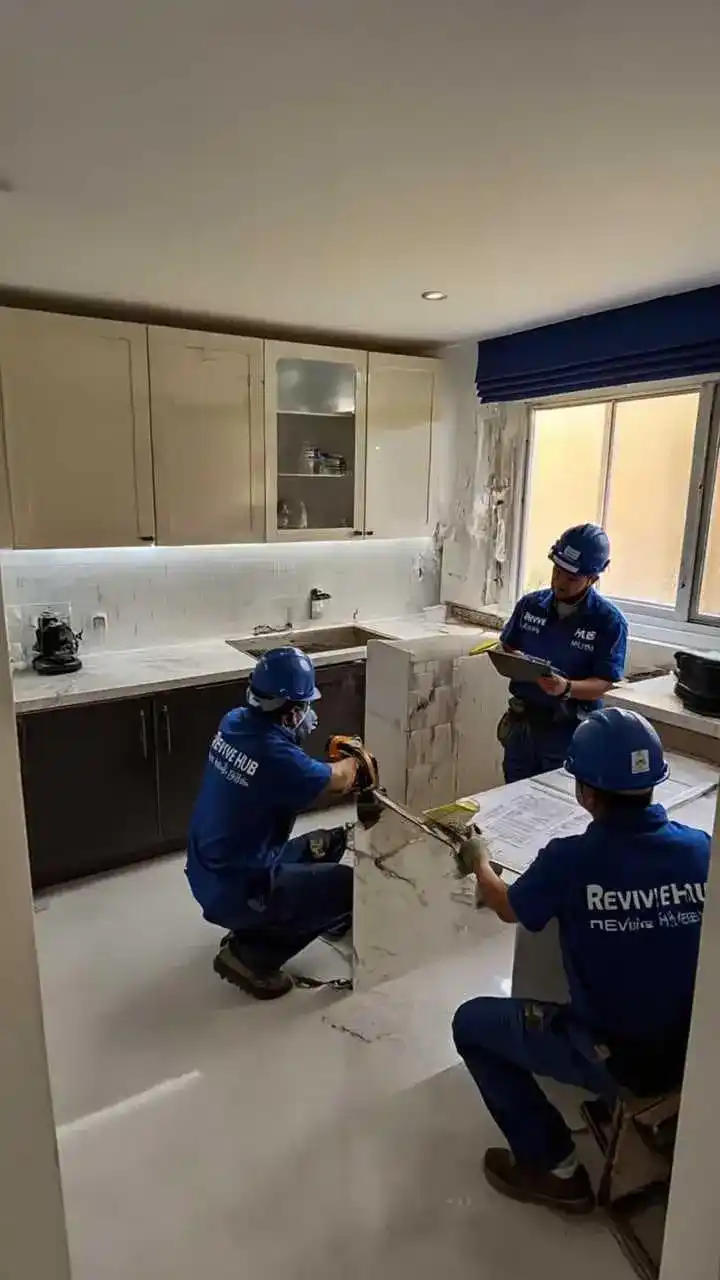
The six flooring decisions most Dubai owners need to settle first
You do not need to choose a contractor or tile brand before you understand these six decisions. Record them first; quotations become easier to compare afterwards.
1. What area are you pricing?
Use measured floor area in sqm, then show tile-order quantity separately. A planning allowance may be useful for cuts and breakage, but the percentage depends on format, pattern, batch availability and layout.
2. Is the quote material-only, labour-only or complete?
Do not compare a tile-supply price with an installed project price. Ask whether demolition, disposal, base work, adhesive, grout, trims, skirting, protection and VAT are included.
3. What is under the new finish?
The existing base can change method and cost. Record the existing finish, visible cracks or hollow response, level differences, wet-area falls and any known leaks before finalising scope.
4. What does the supplier declare?
Check intended use, size, finish, batch, coverage per carton, cleaning guidance and available technical data. A visual label such as “premium” does not replace a product specification.
5. Which approval route applies?
Start with the landlord, building manager or master developer. The route changes with property, tenure and scope; do not rely on a blanket statement that every retiling job does—or does not—need approval.
6. What will be accepted at handover?
Write down layout reference lines, visible cuts, grout tone, transition heights, cleaning, snag review, care information and any stated warranty terms before work starts.
Dubai flooring cost planning ranges reviewed 14 August 2026
The following figures are Revive Hub planning bands for early budgeting. They are not Dubai Government rates, independent market averages or a binding offer. A site-specific written quotation controls.
| Planning scope | Early range | What the figure helps with | Confirm before relying on it |
|---|---|---|---|
| Installation only | AED 25–55/sqm | Labour-side starting point where the client supplies tiles | Tile size, pattern, base readiness, cuts, adhesive, grout, access and VAT |
| Porcelain material only | AED 45–140/sqm | Early material selection band | Brand, declared specification, finish, batch, coverage, delivery and waste |
| Porcelain material + installation planning band | AED 70–195/sqm | Simple combination of the two bands above | It does not automatically include removal, base repair, wet-area work or approvals |
| Bathroom floor tiling | AED 1,200–3,500 | Small wet-area budget direction | Waterproofing responsibility, falls, drain interfaces, wall work and sanitary items |
| Apartment tiling | AED 6,500–18,000 | Early living/bedroom tiling direction | Measured area, occupied-home protection, demolition, base condition and building access |
| Villa flooring | AED 18,000–65,000+ | Larger floor-replacement direction | Area, stairs, large-format handling, skirting, transitions, external areas and phasing |
| Office flooring and tiling | AED 9,000–45,000+ | Commercial planning direction | Work hours, approvals, protection, programme, zones and staged handover |
Two live UAE tile supplier price checks for 60×120 / 600×1200 formats
These checks help readers see why “tile price” needs a unit and date. They are examples from public supplier pages checked on 14 August 2026—not a complete Dubai market survey, endorsement or guaranteed checkout price.
Danube Home UAE
AED 24–145 displayedThe checked 60×120 category showed current product-card examples from AED 24 to AED 145. Cards also referenced carton coverage such as 0.72 sqm or 1.44 sqm, while several products showed struck-through list prices up to AED 199.
Before comparing: confirm whether a displayed number applies per piece, carton or sqm; then confirm stock, VAT, delivery, batch and returns.
Check Danube Home’s live 60×120 catalogue ↗TilesMan UAE
AED 48–90/m² examplesChecked 600×1200 product examples showed sale prices from AED 48/m² for selected matt or glossy porcelain to AED 90/m² for a checked matt R11 example. Product and sale availability can change.
Before comparing: verify finish, declared intended use, origin, thickness, stock, batch, delivery, VAT and whether a sample represents the supplied batch.
Check TilesMan’s live UAE catalogue ↗Material questions to ask for each Dubai room
There is no universal “best tile” for every Dubai property. Intended use, water exposure, cleaning, traffic, substrate, transitions and supplier-declared data matter more than a generic product label.
| Area | Practical starting point | Ask the supplier for | Ask the installer to confirm |
|---|---|---|---|
| Bathroom floor | Porcelain or another product declared suitable for the intended wet use | Slip information for the intended condition, water-absorption data, cleaning guidance and batch | Falls, drain interfaces, joints, sealant and waterproofing responsibility |
| Bathroom wall | Ceramic or porcelain compatible with the wall build-up | Size tolerance, weight, finish, cleaning and intended wall use | Substrate readiness, setting-out, trims, cuts and wet-zone interfaces |
| Kitchen floor | Durable, cleanable finish selected around actual household use | Stain/cleaning guidance, finish, batch and product coverage | Transitions, cabinet interfaces, appliance clearances and visible cuts |
| Living and dining | Porcelain, engineered wood, LVT or another system matched to use and base | Declared application, care, shade variation and carton coverage | Flatness, reference lines, movement detailing, doors and skirting |
| Bedrooms | A finish selected around comfort, acoustics, cleaning and continuity | Maintenance instructions, underlay/system requirements and warranty conditions | Base, thresholds, door clearance and room-to-room levels |
| Balcony / outdoor | An exterior-declared system suited to wet and weather exposure | Exterior-use declaration, wet-use slip data, thermal/UV guidance and care | Drainage, waterproofing interface, thresholds, falls and movement details |
| Office | Commercial-use porcelain, LVT or another documented system | Traffic/use class, maintenance, replacement availability and fire/acoustic data where relevant | Work zones, access hours, subfloor, transitions and staged handover |
Existing-base and installation checks before any tile is fixed
A new surface does not remove uncertainty beneath it. The safest quotation states what was observed, what is assumed, what will be checked after exposure and how variations are approved.
Reference layout
Record the starting line, tile direction, joint alignment, focal points and where narrow cuts may appear.
Flatness and levels
Record observable variance, door clearances, room transitions and the proposed correction method where required.
Wet-area interfaces
Clarify falls, drains, thresholds, waterproofing responsibility, perimeter joints and sealant.
Compatible system
Name the tile, substrate, primer, adhesive, grout and sealant—or state the performance requirement and approval route.
Cuts and edges
Identify visible cuts, specialist cutting, trims, skirting, breakage responsibility and spare-tile handover.
Protection and curing
Follow product instructions for curing and loading; define access control, protection, cleaning and handover timing.
| Observed issue | What it may indicate | Useful next check | Avoid assuming |
|---|---|---|---|
| Hollow response when tapped | A local difference in support or bond may exist; the sound alone does not identify the cause or severity | Map the area, review movement/cracks and obtain an appropriate inspection before deciding method | That every hollow sound means immediate failure—or that it is harmless |
| Cracked grout | Movement, joint condition, installation detail or local loading may be relevant | Check crack pattern, tile movement, edges, interfaces and moisture history | That replacing grout alone will always solve the cause |
| Lippage / uneven edges | Tile tolerance, substrate, setting-out or installation may contribute | Compare product tolerance, layout, lighting and substrate records | That every visual difference has the same cause or remedy |
| Water pooling | Falls, drain position, threshold or obstruction may be relevant | Record water path and obtain wet-area assessment before covering or altering the surface | That a different tile finish alone corrects drainage |
What a useful Dubai flooring quotation should make clear
A single lump sum is difficult to compare. Ask each bidder to use the same measured area and separate the following decisions in writing.
| Quote line | What should be written | Why it matters | Variation question |
|---|---|---|---|
| Measured area and quantity | Floor area, skirting length, tile-order quantity and allowance | Separates installed area from purchased material | Who approves extra quantity? |
| Existing finish | Retain, overlay or remove; disposal and protection | Changes access, programme and base exposure | What happens after the old finish is removed? |
| Base preparation | Assumptions, inspection, local repairs, levelling and exclusions | Base uncertainty can change method and cost | How is unforeseen work measured and priced? |
| Materials | Tile code, batch, size, finish, coverage, primer, adhesive, grout, trims and sealant | Prevents substitution and vague “equivalent” wording | Who approves a substitution? |
| Layout and finishes | Reference lines, pattern, joint tone, cuts, transitions and skirting | Sets visible acceptance criteria | How are layout changes recorded? |
| Approvals and access | Responsible party, documents, fees, work hours, lifts and deposits | Property rules can affect mobilisation | What is excluded if an authority asks for more? |
| Programme and handover | Sequence, curing basis, protection, snag review, cleaning and care information | Defines when the floor can be accessed and accepted | What evidence closes each milestone? |
| Commercial terms | VAT, payment milestones, validity, exclusions, cancellation and stated warranty terms | Allows like-for-like commercial comparison | Can any variation proceed without written approval? |
A stronger flooring project brief
- Property type and Dubai community
- Owner or tenant status
- Measured floor area in sqm
- Rooms and wet areas included
- Existing finish and known issues
- Preferred material, size and pattern
- Building access or NOC information
- Photos, target timing and occupancy
Dubai flooring approvals: who to ask first
Requirements can differ by property, landlord, building manager, master developer, free zone and scope. Start with the current property checklist and use the relevant authority route; do not treat a neighbour’s experience as approval for your project.
| Scenario | Safe starting action | Who normally confirms the route | Do not assume |
|---|---|---|---|
| Like-for-like finish change | Request the current alteration and contractor-access checklist | Landlord, building management or master developer | That “cosmetic” automatically means no NOC |
| Removal affecting screed or base | Describe the exact method and ask whether technical review applies | Building management, consultant and relevant authority | That all base work follows one Dubai-wide route |
| Drainage, falls or waterproofing interface | Obtain project-specific technical and approval advice before work | Building, consultant and relevant authority | That retiling alone resolves an underlying wet-area issue |
| Commercial office flooring | Check landlord, free-zone, access and fire/life-safety requirements | Landlord, free zone, relevant professional and authority | That residential rules apply to commercial fit-out |
| Tenant-requested flooring change | Obtain written owner approval before committing to scope | Owner/landlord and property management | That verbal permission is enough |
How Revive Hub moves from a planning enquiry to an executable flooring scope
This is the company’s proposed workflow. Eligibility, timing, deliverables, fees, approvals, payment stages and warranty terms depend on the property and written offer.
Photos, measurements and property context
The enquiry records property type, Dubai community, measured area, rooms, existing finish, visible concerns, access and target timing.
Existing-condition and risk review
The team identifies what can be assessed from the enquiry and what needs site verification before final method or price.
Initial visual direction for suitable enquiries
Tile direction, grout tone and visible layout options may be compared. The visual supports decisions; it is not a technical drawing, product certification or authority approval.
Written scope, assumptions and commercial terms
The offer should state inclusions, exclusions, materials, base assumptions, approvals responsibility, programme, milestones and the mechanism for variations.
Execution checks, snag review and handover
If appointed, the project follows the agreed scope, manufacturer requirements, property rules, quality checks and documented handover route.
Choose the Revive Hub page that matches the work—not just the room name
Flooring can sit inside a larger renovation. These short links help users move to the page with the correct primary intent and reduce mixed enquiries.
Questions readers ask after comparing flooring options
No. This URL is the informational planning guide. For contractor scope, booking, site review and quotation route, use the Flooring and Tiling Dubai service page.
Revive Hub’s early planning bands are AED 25–55/sqm for installation only, AED 45–140/sqm for porcelain material and AED 70–195/sqm when those two bands are combined. They are company planning figures, not official tariffs or a quote. Removal, disposal, base work, wet areas, access, approvals and VAT may be additional.
No. They are dated observations from public catalogue pages checked on 14 August 2026. Confirm the unit basis, live stock, sale status, VAT, delivery, batch, coverage and return rules directly with the supplier.
There is no universal answer. Start with a product declared suitable for the intended wet use, then verify slip information, water exposure, cleaning, falls, drainage, joints and waterproofing interfaces. Do not treat one R-value as a universal Dubai legal rule without confirming the project requirement.
Not necessarily. A hollow response can indicate a local difference in support or bond, but sound alone does not determine cause, severity or remedy. Map the area and obtain an appropriate inspection before choosing repair or replacement.
Do not use a blanket yes or no. Requirements vary by property, landlord, building manager, master developer, free zone and scope. Ask for the current alteration and contractor-access checklist for the exact property.
Start with written owner or landlord permission and the property’s current alteration rules. Responsibility for approvals, reinstatement and costs should be recorded in writing before committing to work.
Revive Hub states that suitable enquiries may receive a complimentary initial visual direction before a project deposit. It is a planning visual—not a technical drawing, quotation, approval or unlimited design service. The written offer defines eligibility, revisions, charges and payment terms.
Send property type, community, measured sqm, rooms, existing finish, known issues, preferred material/size, photos, owner/tenant status, access/NOC information, occupancy and target timing. The contractor can then state what still needs site verification.
It may improve presentation, but no uplift or payback is guaranteed. Location, property condition, supply, tenant demand and the wider market matter. Use the official DLD Rental Index and suitable property advice instead of a generic ROI percentage.
How this guide separates evidence, observations and company information
Planning prices
Project and per-sqm ranges are labelled as Revive Hub company planning figures. They are directional and do not claim to be official tariffs or independent averages.
Supplier observations
Two public UAE supplier pages were checked on 14 August 2026. Displayed figures are dated examples; no ranking or product-quality conclusion is drawn from them.
Authority guidance
The page links to current Dubai Municipality and Dubai Land Department resources. Property-specific requirements still need confirmation from the correct party.
Technical boundaries
Material and installation sections are question frameworks, not engineering, waterproofing, structural, fire-safety, legal or manufacturer certification.
Company process
Revive Hub’s workflow and First See Then Pay wording are clearly labelled as company statements. The written offer and project documents control.
Update policy
Supplier listings, rates, authority routes and external pages can change. Recheck live information before purchase, appointment or approval submission.
Sources checked for this 14 August 2026 review
- Dubai Municipality — Dubai Building Code overview
- Dubai Municipality — building permit procedures
- Dubai Municipality — building and planning circulars
- Dubai Municipality — official service directory
- Dubai Land Department — official Rental Index
- ISO — ISO 13006:2018 ceramic-tile classification reference
- Gulf News — Q1 2026 Dubai building-permit context
- Danube Home UAE 60×120 catalogue and TilesMan UAE 600×1200 product examples—commercial links are provided once in the supplier section with
nofollow. - Revive Hub company planning bands, process description, service list and business information—reviewed 14 August 2026.
Who wrote and reviewed this guide

Jamshed Ahmed
Jamshed is identified by Revive Hub as the founder responsible for the company’s flooring planning bands, service workflow and scope-comparison framework. Company information is labelled; external supplier and authority statements are linked separately.
Author update: .

Nayab Zahra
Nayab reviewed the tile-direction, grout-tone and initial-visual-direction wording. Her review is limited to architectural visualization and material presentation; it is not structural, waterproofing, MEP, legal or authority certification.
Expert review: .